
Fata Morgana
Fata Morgana
Christine Boyer
Daria was always caught up in her games of pretend.
Eleven years old and the youngest daughter, she trailed her elder sister. At fifteen, Maryanne had crossed the unfathomable gulf between childhood and adolescence, leaving Doria behind to her make-believe games. It was easy for Doria to wander away alone, to lose track of time and tide. She lost herself in her made-up worlds, which were far more magical than the family home—a wind-blasted salt-box along a sandy lane where the adults whisper-fought about inexplicable adult things like foreclosures and liens.
Musgrave Island was no enchanted kingdom, but it was easy to pretend. Doria spent most of her days at the shore. She waded through tidal pools, shielded her eyes against the white glare of the sun. She pretended she was a marooned sailor, the sole survivor of some calamitous storm. She poked around stinking low tide, picked the wrack line for treasures.
So engrossed in her exploring, so lost in her made-up stories, she was often surprised when the tide turned. The licking pull of the current tugged at her feet, foamed around her knobby knees, and she’d realize she had lost entire hours living in her own inventive mind.
*
She brought home bits of dusky purple quahog clams, driftwood sanded down to silkiness. A cuttlefish bone bigger than her palm. A shard of sea pottery, white with a bit of blue scrollwork. She lined them up on the windowsill in her bedroom.
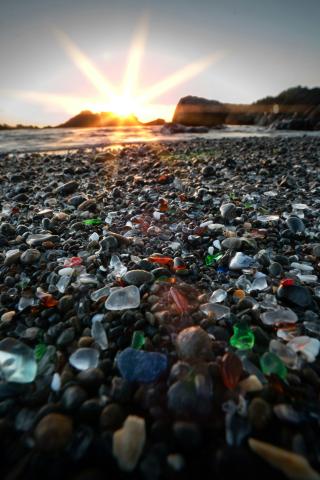
Her best find was a piece of milky sea glass the size of a snow bunting’s egg. She held it to her eye and pretended it was magical, that it could reveal hidden truths. She liked to scan the horizon with it, that narrow line where the gray sky met the gray sea.
Sometimes she saw mirages. Fata morgana, their grandmother used to call them. Fairy castles built on the air. They shimmered tantalizingly: close enough to see, too distant to visit.
*
Her parents indulged her pretending, benignly neglectful like many of the parents on Musgrave Island. They had their own grown-up worries. There seemed to be less lobster and fish each year. Traps were often hauled up from the sea dripping and empty, and nets netted trash—bald tires, bleached plastic detergent bottles—as often as cod. So long as Doria was home by sunset, her parents were fine with her solitary adventures.
It was Maryanne who tormented the younger girl for her pretending games. Some of those grown-up worries spilled over onto the elder girl, and they shoved her further from her own childhood. She had a better understanding of those baffling adult terms—lien, adjustable rates—or if not understanding, at least the dread they could evoke.
She’d taken a part-time job, and each hour at the bait shack widened the gulf between her and Doria. Maryanne seemed to resent her younger sister’s freedom to play and pretend. She tried to shame Doria into growing up too. She pointed out how all of her games were childish, how much the younger girl acted like a baby.
“You know there’s no such thing as fairies,” she told Doria once with a scoff.
“There is.”
“Isn’t.”
“Why would you even want to find a fairy?” Maryanne asked another time. She reminded Doria of their grandmother’s stories, old ones passed down from her own grandmother’s grandmother in the old country, that green and rainy place their family had come from before they left to settle on Musgrave Island. In those stories, fairies weren’t like the creatures in the cartoons, all pink and gossamer wings. Those Old World fairies had their own courts, their own laws, their own tricky ways of ensnaring unwary humans.
Another time: “Fairy is just a different word for witch.” Maryanne twisted her hands into claws and chased Doria. When she caught her, she pinched at her sides until the younger girl cried.
Doria tattled to her parents, who grounded Maryanne. The elder girl stopped in her bedroom doorway before bed that night. Her eyes were red-rimmed from crying; she looked ghostly in her white nightgown.
“I hope fairies are real,” she hissed at Doria. “I hope one grabs you at high tide and drags you out to sea and no one ever finds you.”
*
Their father was the first to disappear. Or, more precisely, he was the first Doria was aware of.
It was true people had been leaving Musgrave Island for years. Some planned it out months in advance, a slow leave-taking of selling and giving away the belongings they couldn’t carry with them, of farewell dinners, of toasts at the bar near the wharf. Others slipped away in a single moment: there one minute, gone the next.
It was just that Doria’s father was the first she personally knew to disappear. Plenty had gone before him.
*
Doria overheard her parents fighting in the kitchen the night before her father disappeared. Sound carried in the small house, but she pressed her ear against the wall of her bedroom to hear better.
“There’s work on the mainland,” she heard her father say.
“You’re abandoning us,” her mother replied. An accusation.
“It’s just a few days, just to look.” A beat, a sigh. “I can find work. A place to rent. It’ll be a new start for us.”
Her father planned to meet John Swain on his boat the next morning. The two were both bound for the mainland and could share the trip. Doria’s mother pointed out that the ferry ran an early morning route. Her father replied that every penny counted, and if he could save on fare, he should.
*
No one knew for sure if the men reached the mainland. It was true that a terrific squall blew up that morning at dawn. Weather like that had been blowing boats off course for generations. The shoreline of the mainland was pocked with inlets and bays, fingers of peninsulas reaching into the ocean. Maybe they ended up in some mudflat or salt marsh, overshot from their targeted destination.
It was also true that John Swain was a known drinker. Though he limited it to the evenings most of the time, the emptying fisheries had hit him just as hard as others. Maybe his hands had been shaky, his reflexes too slow when the storm came upon them on the open sea.
Or maybe the two men just moved on. Both had families dependent on them. Families—even beloved ones—could be a weight tangled around an ankle, drawing a man under. Everyone knew the codfish were dwindling, and projections were bleak that they’d return in their lifetime. Maybe the idea of starting over on the mainland, of shedding their families and rickety boats and bank loans like jetsam was too good to pass up.
Word was sent to the mainland to look for them, but no one saw the boat or the men. Months later, some flotsam drifted onto the shore of Musgrave Island. There was a faded quoit, a piece of curved wood that may have been part of a hull.
Sarah Swain swore it belonged to her husband’s boat. She ran a thumb over the flaking blue paint. She said she knew the shade—her husband had painted his boat to match her eyes.
*
There was a service. They gathered at the family plot with its sunken depressions of the older burials, the heaped mounds of the newer ones. There was talk of getting a stone, but money was tight, and it was expensive to have even a simple marble one shipped in. The best they could do was the cheap metal placard provided by the funeral home.
Doria studied the other grave-markers in the churchyard. They were crooked and slanted from the island shifting over time. The older limestone ones were nearly illegible from the constant salt wind. She tried to read them but she could only make out a few names, a word or two of the inscriptions, a scattered number of a birth or death date.
Beloved wife of Jos. Sacred to the memor. Depart this life.
She held up her piece of sea glass and peered through it. She saw the churchyard, the group of mourners turned misty, ghostly.
*
Maryanne was the second to disappear.
She left a note. She explained in her neat, rounded-off handwriting that she was taking the ferry to the mainland. She was going to stay with Molly Swain until she found work. The eldest Swain girl had left Musgrave Island after the disappearance of her own father, and she had flourished once she found her footing there. Maybe Maryanne felt the same hopefulness of a new start.
They knew she made it to the mainland. They received two letters—brief ones, not sentimental. She gave them the phone number to Molly’s apartment, and she promised to send money when she could.
Two letters and then nothing.
*
Time passed. They assumed Maryanne melted into the mainland like so many did. A new life on stable ground, no tethers to the dying island. No bad memories or haunting ghosts.
Doria walked down the sandy lane, past the old churchyard with its crooked graves. The island was shaped like a comma, and she walked down the long, sandy stretch with the ocean on each side of her. The Swain family lived on the spit that arced into the ocean.
She wanted to visit Sarah. Her family had been battered too—husband disappeared, daughter gone to the mainland. Maybe she had news, though, of her daughter…and by extension, news of Doria’s sister. There hadn’t been a letter from Maryanne in ages.
She found the woman sitting in a water-stained old chair at the back of the house. She stared off at the horizon, and a forgotten cigarette smoldered between her pinched fingers. When Doria tried to engage with clumsy small talk, miming what the adults around her always talked about—an opening salvo about the warm weather, the promise of coming rain—the woman didn’t answer. She only sighed and watched the horizon as twists of smoke drifted on the wind.
Doria gave up and walked home. Inside, stuck to the refrigerator with a magnet, she found the slip of paper with the phone number for Molly Swain’s apartment. She lifted the receiver of the phone and dialed.
The phone rang and rang. She hung up and pulled her sea glass out of her pocket. She turned it over and over in her hand, felt the cool smoothness of it soothe her. She tried the number again, listened to it ring again.
The third time she dialed the number, there was no ringing and no audible click of someone picking up the phone on the other end.
“Hello? Maryanne?” she whispered. “Are you there?”
No answer. There was just a staticky shushing in her ear, like the roiling rush of an incoming tide.
*
Things eroded.
Her mother, like Sarah Swain, spent her days smoking and looking out the window towards the sea. Doria wandered the island; she walked the parameter of the island, took the north side one day and the south side another. She walked the spit and felt the power of the ocean on either side of her. She went to the wharf and watched the remaining fishing boats come and go, their empty nets dripping limply. She sat on the steps of the church and kept watch over the graves.
Sometimes her mother came to the churchyard. Doria always ducked behind the dogwood tree when she did. She figured her mother wanted a private moment at the family plot, to pray or reminisce.
Standing behind the tree, Doria reached into her pocket. She pulled out the piece of sea glass and held it up to her eye, sank into the old game of pretend. She wanted to see if any hidden truth would be revealed.
She only saw her mother turned gossamer as a ghost. She floated among the gravestones that gleamed like teeth where they sprouted from the loamy ground.
*
Other people disappeared, but the moment Doria heard of someone who had vanished, she immediately forgot it. Time became slippery, and each today bled into each tomorrow.
People disappeared from Musgrave Island. It was just what happened.
*
Her mother disappeared next.
But disappeared was not the right word. When Doria thought of the right word, her throat got tight and her lungs felt like they’d burst in her chest. The world around her turned filmy, as if she were looking up at the sun from underwater, the salt stinging her eyes and throat as she fought to breathe.
Disappeared didn’t capture the sight of her mother on the kitchen floor, her face frozen in a grimace, her wide eyes unseeing from the stroke or heart attack that killed her.
A local boy, the son of the church’s sexton dug the grave. Doria stood nearby and watched; the sexton’s son was known to be lazy, and she wanted to make sure the hole was deep enough. He was the type to do a job carelessly, and she wanted her mother to rest easy.
Three feet down, the sandy soil turned brackish, then marshy. Four feet down, it was standing water.
The island is disappearing too, she thought, but as soon as the realization floated to the top of her mind, she forgot that too.
*
There was a nor’easter early that season. No one thought it would do much damage; the islanders were used to the battering storms that pounded their way across Musgrave Island. They thought their lights may flicker, the rain may spatter harder against their windows, like it usually did.
The storm knocked out the power immediately. The families left on the island huddled in their homes as the wind lashed and howled from all sides. They fell into uneasy sleep, their dreams thin and full of shrieking.
When they woke and surveyed the damage, the spit of land was gone: the island once shaped like a comma was now a period.
Gone too were the few homes there. The abandoned one that bored teenagers used to drink and smoke in. The Swain home with its peeled paint, its windows that rippled in the light, warped in their frames.
And Sarah Swain with it. She never gave up on her husband returning or her daughter coming home, even all those years later. Maybe the nor’easter was merciful and took her to them in the end.
*
In school, Doria had been fascinated by math. Multiplication had dazzled her: how two by two became four, four by four became sixteen. How quickly the numbers could stack up, how fast doubling crowded the world.
Now she realized the horror of the inverse—how quickly things disappeared when they were halved. And then halved again and again until only a thin margin existed, a portion of a whole.
Her family had been eroded. She was the only one left, and even she—the remainder—was just a portion of a whole. She saw it when she caught her reflection in a pane of glass or the still surface of a tidal pool. She had been eroded, the plump, ruddy face of childhood chiseled away until she was thin and pale as a wraith.
Doria, ground down by the relentless sand and salt and wind. Worn down by time, her edges smoothed like the limestone grave-markers with their disappearing words. A jagged piece of glass tumbled along the dark, sandy bottom of the ocean until she found herself on the shore, transformed.
*
Musgrave Island was being eroded too.
The nor’easter that took the curved strip of island with it was the start. Every year since, the sea took more, bit into the island, and swallowed it. The wide, sandy beaches disappeared. High tide came up to the grassy dunes. The salt water killed the grasses, and then the dunes—no longer stitched together by intricate root systems—returned to the ocean.
The population eroded. After Sarah Swain was swept out to sea, half of the remaining families left. They packed up, cut their losses. From there, it was a steady trickle, grains of sand ticking through an hourglass. A family here, a couple there. Each year, every year until only Doria and a handful of people, mostly stubborn old folk, remained.
The bait shack where Maryanne used to work shuttered, then eventually caved in once the roof, soft with age, failed. The wharf side bar closed too, its windows boarded over with gray particleboard.
The ferry cut its service from one daily route to thrice a week. Then it was cut to once a week. Finally it was cancelled altogether.
*
Doria had always lived in her own world, and now Musgrave Island was all hers. It sank, its shorelines were nibbled away by the sea an inch at a time, but it belonged only to her now. Everyone else was gone. Most of the birds were gone too. They found sturdier ground to winter on, leaving only the shrieking gulls and the rare eider as company.
She kept the cemetery as neat as she could. She remembered when she was young, how she and her family would spend a spring weekend at the family plot, cleaning up stones and planting fresh flowers that would be dead by the end of summer. It felt important to keep up the tradition, even if she was the only one left.
She tried to straighten the stones in the marshy ground, scraped away the lichen that always returned in full force. She tried to not think much on her kin buried there. She tried not to think about their caskets, flimsy pine boxes being drowned by the brackish water that was overtaking the island.
She prowled the abandoned houses. She stood in the middle of rooms that looked as if their owners had only stepped out for a moment. They had left behind so much, in the end: photos and Bibles with family genealogies written in elaborate script inside the covers. They left clothing and stuffed animals threadbare from being loved too hard by children. They left pots and pans rusted and pitted, dishes that had held a thousand meals. They left half-empty bottles of shampoo and leather dog leashes that spouted furry mold and magazines grown thick and swollen with moisture.
Doria surveyed the homes. She witnessed them and then left them to their ghosts.
She stayed in the family home, the wind-blasted salt-box along the sandy lane, though she slept in the living room. She had abandoned the upstairs when a gale tore away a section of shingles. In the winters which weren’t that cold anymore, she swaddled herself in quilts that had been faded even when she was a child, and she slept.
*
Sometimes she saw boats.
It was easy to fall back into the fairy tales and games of pretend from her youth. Sometimes the boats were far away, shimmering unsteady on the horizon. Doria convinced herself they were fata morgana, those fairy castles of the air that she never quite found a way to get to.
Sometimes the boats came closer. She guessed that some of them were fishermen from the mainland testing the waters to see if the codfish had returned, just as Musgrave Island was disappearing.
*
People came to the island once. They didn’t just travel around it; they actually stepped foot on it.
Doria heard them coming: the motor on their boat, their low voices a murmur as they tied up at the rickety dock. The island noise was monotone now, just the constant wind through the oatgrass, the constant waves eroding away at the margins. Even the gulls had left by then.
It looked like a family. There was a man with a camera around his neck, and a woman who clutched a small cardboard box in her hands. There was a girl who could either be a tall ten-year-old or a young teenager—Doria never was a good judge of age. Both the woman and the girl had faces that sparked against Doria’s memories, but they were so muddled anymore that she couldn’t quite place the familiarity.
Maybe it’s one of the Swain girls all grown up, with her own daughter now. Come back home for a visit, Doria thought.
She followed them at a distance as they made their way through the island. Doria had been alone for so long, the sole inhabitant of Musgrave Island, that she felt an uneasy twist in her stomach at the sight of the family. Solitude had made her strange, perhaps, so she stayed out of sight, drifted behind them as they climbed up onto the rotting dock, as they meandered past the collapsed winches of the wharf, the boarded-up bar, the tumbledown bait shack. Down the main street pocked and overgrown with grasses, towards the cemetery.
The church had held up the best on Musgrave Island. The wrought iron cross that had adorned the top of the steeple had fallen at some point, but the building was mostly intact. The paint had peeled off, long scabs of dirty white littering the ground, but the church would probably be the last building standing when the island finally gave way to the ocean.
In the churchyard, the family split up. They each took a side of the cemetery and started walking the uneven rows. They bent their heads to study the inscriptions on the stones, sometimes exclaiming at an old name or inscription that tickled them in some way.
Doria ducked behind the gnarled dogwood tree, just as she had when her mother was alive and would visit. Maybe they wanted a private moment to pray or remember their people buried there. The man paused every few steps and snapped a picture with his camera. She could hear the wet squelching of their steps: the cemetery was steadily sinking along with the island, and it had ceded from sandy to marshy long ago.
It was the girl who found the plot.
“Over here!” she called out, waving her arm at the man and woman. Both made their way to where she stood, bouncing excitedly on her sneakered toes. Doria crept out from behind the dogwood and followed too.
They stood over her family’s plot. The three of them looked down at the older stones—Doria’s grandparents and great-grandparents and even further back—the worn-down limestone with their smooth faces and lost names. They looked at the newer markers too.
It shamed Doria that they were never able to give her father a stone, and that she never got one for her mother. That the best she could do was keep watch over them, keep their plots as trimmed and neat as possible, and hope it was enough.
“Mother never got over it,” the woman said. She knelt, mindless of the wet ground soaking her jeans. “She always blamed herself.”
The man stood behind her, laid a hand on her shoulder. He squeezed her gently as she opened the lid of the box she carried. She pulled out a gunmetal gray container and sat it on the ground.
“Grandma blamed herself?” the girl asked.
The woman nodded. “She and her sister had a fight. The next day, her sister disappeared. They never found her, but she was always playing down by the shore. They guessed she got swept out to sea when the tide came in.”
“Why was that Grandma’s fault?”
“It’s hard with sisters sometimes.” She reached out and brushed away some of the salt-crust from the little metal plaque. “I guess my mom told her sister during their fight that she hoped she’d drown. And then when she did…” She trailed off, sighed. “The family fell apart after that.”
The girl knelt beside her mother and picked at the rime on the metal plaque too. She peered closer at the dates, did the math in her head.
“She was only eleven.”
Her mother nodded. She twisted the metal urn, pressed it firmer into the ground, then patted the top of it. “That’s why she wanted her ashes brought back here, even though the island will be gone someday. She wanted to come home in case Doria was waiting for her.”
*
She doesn’t remember the family leaving. Her family, a living branch of her family. Time is such a slippery thing. It was slippery even when she was a child. Time and tide slipped away from her; the sun shot across the sky in a single blink.
It isn’t a revelation to her. She thinks she’s always known, or at least realized in that deep-down place where truth exists even if a person can’t say it out loud just yet. Doria, the child who lived in her own world. She was swept out to sea, then found her way back to Musgrave Island to watch over it. Her home.
There are no fairy castles built on the air near the line of the horizon. There was only ever the salt-box on the sandy lane. Even that is gone now. It caved in from rot and neglect, bits of it blown away by the storms that batter the island.
*
Doria haunts Musgrave Island. She has haunted it for generations. But the island is being halved, over and over, and time is slippery but it seems that her home is disappearing at a faster rate.
Already the cemetery is underwater at high tide. The church tilts to one side, the foundation sinking.
What happens to a ghost when the home it haunts is gone?
She won’t have to find out alone. She reaches into her pocket, pulls out the piece of milky sea glass the size of a snow bunting’s egg. She always looked through it at the living and missed the hidden truth: she isn’t alone, and she hasn’t been for a long time.
Doria holds up the sea glass to her eye. They aren’t hazy. They look just as they did when they were alive. Real. Solid. Her father with his neat-trimmed beard, the white scar that splits his eyebrow where a fishing hook caught him. Her mother with her serious mouth and smiling eyes, crinkled at the corners.
And Maryanne now too. Brought back to the disappearing island to be reunited with her family. Brought home.
*
Maybe it’s hard with sisters sometimes, but maybe childish grudges and words tossed around in a silly fight can die too. And it was such a silly fight. If tragedy hadn’t struck the day after, no one would have even remembered it. Those mean, tossed-around words wouldn’t have haunted her sister as they did.
Doria gazes at the horizon through her sea glass. There’s a fata morgana there, shimmering in the fiery beginnings of sunset.
“Why would you want to find a fairy?” Maryanne asks, standing beside her.
Doria shrugs. She can’t think of a good answer: it’s just the adventure of the unknown, she guesses, of discovering a new world that lies just beyond the shores of the island she never left. She tries to form her thoughts into words but then shrugs again.
“I dunno. I just want to,” she says.
Her sister snorts softly beside her, but then Doria feels Maryanne’s hand in her own. She glances up at her big sister and sees the smile that curves her cheek.
“Okay then,” Maryanne replies. “So let’s go.”
Photo by Joshua Sortino on Unsplash